How To Create An Indicator
Create A New Indicator
The "Create Indicator" page in the M&E Monitor allows users to add new Indicators that are aligned with the objectives outlined in their Theory of Change. This process involves defining the specific metric to be tracked, setting baseline and target values, and specifying the type of progress being measured. By creating Indicators, users can monitor project outcomes, assess performance, and ensure that activities are contributing to the desired goals. The page provides a user-friendly interface for entering the necessary details to establish meaningful and measurable Indicators.
Procedure for Creating Indicators
Categorizing Indicators
Categorizing your Indicator helps organize and track its purpose effectively. Available categories include:
- Outcome: Measuring long-term effects or changes resulting from the project.
- Output: Tracking immediate products, services, or results delivered by the project.
- Impact: Assessing the broader, long-term impact of the project on the target population or environment.
- Input: Tracking the resources invested, such as time, money, or materials.
- Process/Activity: Monitoring the steps taken or activities conducted to achieve the project objectives.
- Efficiency: Evaluating the relationship between the inputs used and the outputs produced.
- Effectiveness: Measuring how well the project’s outputs achieve the intended outcomes.
- Sustainability: Assessing the likelihood of the project’s benefits continuing after completion.
- Equity: Examining fairness and inclusiveness of the project’s impact across different groups.
- Cross-Cutting or Context: Related to broader issues influencing outcomes, like gender or climate change.
- Uncategorized: Indicators that have not yet been assigned a category.
Direction of Progress
Understanding the direction of progress is crucial for interpreting your Indicators correctly:
-
Increasing Direction: For an Indicator to show an increasing direction, the baseline value must be less than the target value. This signifies growth or improvement in the measured area.
-
Decreasing Direction: Conversely, for an Indicator to indicate a decreasing direction, the baseline value must be greater than the target value. This reflects a decline in the measured area.
Other Indicator Details
- Indicator Description: Provide a brief and descriptive title for the indicator.
- Definition: Explain how the indicator is calculated, including any formulas or methodologies used.
- Progress Direction: Choose "Increasing" if the baseline is less than the target; otherwise, choose "Decreasing" if the baseline is greater than the target.
- Baseline: Enter the current value of the indicator, which serves as a reference point for measuring progress.
- Target: Set the target value, indicating the desired outcome for the indicator.
- Data Source: Specify how the data will be collected, detailing the methods and tools used to gather information.
- Frequency: Indicate how often the data will be collected (e.g., monthly, quarterly).
- Responsible: Identify who is responsible for measuring the indicator, ensuring accountability for data collection and reporting.
- Reporting: Mention where the results will be reported, providing clarity on the communication of progress and outcomes.
Indicators and Organisations
Indicators created within the M & E Monitor are associated with the organisation of the user who creates them. This association ensures that each Indicator reflects the specific goals, projects, and context of the user's organization. By linking Indicators to organizations, users can:
- Maintain a clear connection between the Indicator and the strategic objectives of their organization.
- Facilitate the reporting and tracking of progress at the organizational level.
- Ensure that all Indicators align with the broader mission and vision of the organization.
Sample form used to create indicators
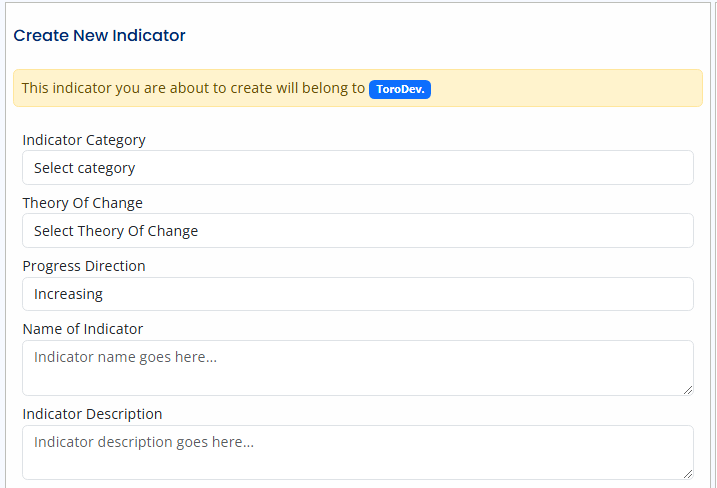
By selecting the appropriate category, defining the direction of progress, and providing comprehensive details about the indicator, you can ensure that your Indicators effectively reflect the project’s objectives and outcomes. Additionally, selecting the relevant Theory of Change will further align the Indicator with the project's goals and expected impacts.